What does a taxi from Munich Airport actually cost?
A taxi from Munich Airport is metered, not a flat fare. The total depends on distance, traffic, and time of day. For one traveler in daylight, the S-Bahn suburban train almost always costs less per person. For three or four people with luggage after midnight, that balance often flips. Munich’s taxi tariff is a municipal rate, reviewed periodically by the city government and published by Landeshauptstadt München — that is the only place to confirm today’s base charge and per-kilometer rate.
The airport sits about 40 kilometers north-east of the city center, near Erding and Freising, well outside Munich’s own district boundaries. That distance is the main driver of the fare. It does not change with traffic, but the time the meter runs does.
How is the fare actually calculated?
German taxi meters combine three elements: a fixed flag-drop charge, a per-kilometer rate, and a per-minute rate that kicks in when the car is moving slowly or stopped. On the autobahn in light traffic, distance dominates. In a backup, the clock takes over.
On top of that, city tariffs typically add a night surcharge. It applies after a set evening hour and before a set morning hour, and the exact window and percentage are set by the city, not by individual drivers. Sunday and holiday surcharges often work the same way. None of these figures are stable enough to print here reliably — check the current schedule on muenchen.de before you travel.
Luggage itself rarely carries a separate fee under German taxi tariffs, unlike in some other countries. What luggage does affect is which alternative makes sense, because a suitcase on a crowded late train is a different proposition than a suitcase in a taxi trunk.
What does the S-Bahn cost instead, and how does that scale per person?
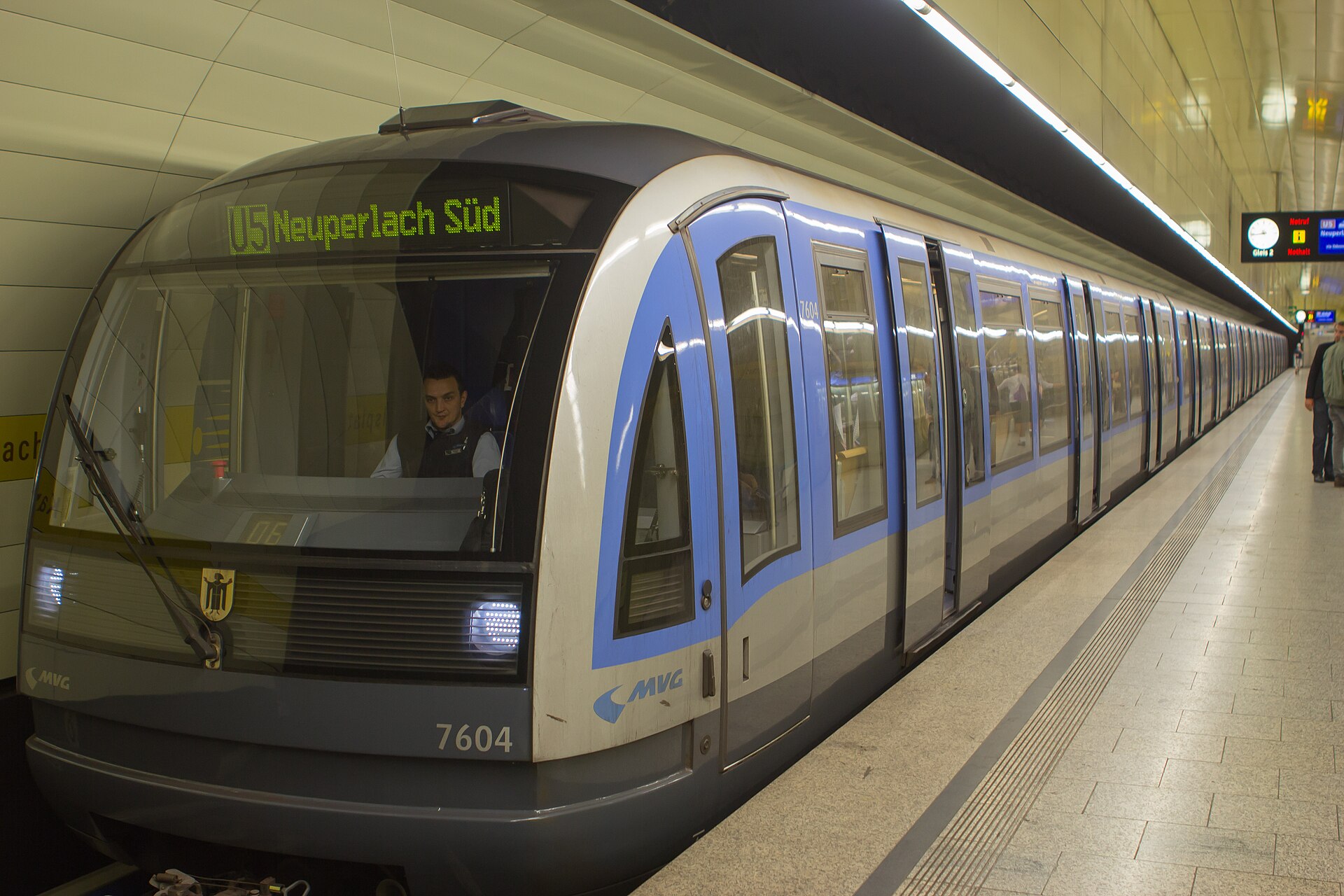
Two S-Bahn lines, S1 and S8, connect the airport to the city center. The published MVV timetable puts the ride at roughly 40 to 45 minutes to Marienplatz, the central square in the Altstadt-Lehel district (Bezirk 1). During the day the two lines combine to a frequent service. Late at night, frequency drops and only one line keeps running.
Fare-wise, the airport sits well outside Zone M, the MVV’s central tariff zone. That means an airport journey costs more than a short hop within the city core, because more rings are crossed. The full mechanics of that zone system, and where Zone M actually ends, are covered in a separate explainer on the MVV zone system. The key point here is structural: an MVV ticket is priced per rider, regardless of how many people travel together. A taxi meter is not.
That single difference is what makes group size the real decision variable, more than the headline fare itself.


Taxi vs. S-Bahn: the break-even table
A taxi fare splits evenly across however many people share the car. An S-Bahn fare does not — each rider pays their own ticket, or a group/day ticket priced by MVV’s own rules. As the group grows, the per-person taxi cost falls; the per-person train cost usually doesn’t, unless a group ticket applies. That arithmetic, not the sticker price of either option, is what actually decides the question.
| Riders | How the taxi fare splits | How the MVV cost scales | Daytime verdict | Late-night verdict |
|---|---|---|---|---|
| 1 | Full metered fare, no split | One zone-based ticket | S-Bahn wins | Depends on last train, but train usually still cheaper |
| 2 | Fare split two ways | Two full tickets | S-Bahn usually still cheaper | Close; check current fares before deciding |
| 3 | Fare split three ways | Three full tickets, unless a group ticket applies | Often close to even | Taxi frequently competitive, especially with bags |
| 4+ | Fare split four or more ways | Four-plus tickets, or one day/group ticket | Taxi often cheaper per person | Taxi usually the practical choice |
The MVV also sells day tickets and small-group tickets, priced under separate rules published on the operator’s own site. Those can shift a two- or three-rider comparison either way, so it is worth checking the current fare calculator rather than assuming the individual-ticket price applies.
When does taking a taxi actually make sense?
Three factors matter more than the headline fare: how many people are traveling, what time it is, and how much luggage there is.
- Solo traveler, daytime: the S-Bahn almost always wins on cost, and frequency is good enough that waiting isn’t a real penalty.
- Two people, daytime: still usually the train, but the gap is smaller than it looks once bags and a connecting U-Bahn or tram ride are factored in.
- Three or more people, any time: the taxi’s per-person cost drops fast, and it may already be close to or below train fares.
- Any group after the last convenient S-Bahn, or when frequency has dropped to one train every twenty-plus minutes: the taxi’s night surcharge is usually a smaller penalty than standing on a near-empty platform with luggage at 2 a.m.
None of this requires memorizing a euro figure. It requires knowing which side of the ledger group size and clock time push you toward, then confirming the actual numbers before booking.

Where do you actually catch a taxi, and what about ride-hailing apps?
Munich Airport publishes current arrival-hall taxi rank locations, for both Terminal 1 and Terminal 2, on its own transport pages — see Munich Airport’s official site. Ranks are marshaled, so cars are dispatched in order rather than chosen freely by arriving passengers.
Ride-hailing apps operate at the airport too, though availability and pickup points shift and are best checked in the app itself rather than assumed from a past visit.
The bottom line for solo travelers vs. groups
The train is the default for anyone traveling alone or in a pair during normal hours. It is fixed-price, frequent, and doesn’t care about traffic on the autobahn.
The taxi earns its keep when a group splits the meter, when the clock has pushed past the S-Bahn’s regular frequency, or when the number of suitcases makes a train platform impractical. For everything else — planning a first visit, working out where the transport network actually starts and stops, or comparing travel-card options over a longer stay — the wider Munich practical guide and the getting-around archive cover the rest of the system. Residents weighing a longer-term transport pass, rather than a single airport transfer, may also find the comparison in München Card or CityTourCard: Which Actually Pays Off? useful, since it works through the same per-person logic over a full day rather than one ride.
Related reading
beer gardens, the breweries and Oktoberfest.
Access Munich is an independent guide written from published, checkable sources. We have not visited the places described here and we do not publish personal recommendations or invented ‘local favorites’ — where something is singled out as notable, we say who says so. Opening times, fares, closures and prices change at short notice, so treat everything here as a starting point and confirm with the museum, operator or venue directly before building a day around it. We give no advice on visas, insurance, health or safety; use your own government’s official guidance for those.
Featured image: Photo by User:Mattes, source, CC BY-SA 3.0
